If you’re dealing with cat urine in your Guelph home, you already know it’s not just a nuisance—it’s a serious problem. Cat urine smells worse and sticks around longer than dog urine, and removing it completely is far more challenging. This isn’t just perception. The chemistry of cat urine, combined with how cats behave after they’ve marked territory, makes cat urine carpet cleaning one of the toughest jobs in the cleaning industry.
MX Carpet Cleaning handled thousands of pet urine cases across Guelph and surrounding areas. We’ve learned what works and what doesn’t and more importantly, why cat urine requires completely different treatment strategies than dog urine. This guide breaks down exactly why cat urine is harder to clean and what you need to do to actually solve the problem.
Why Cat Urine Is Harder to Remove Than Dog Urine
Cat urine is objectively more difficult to clean than dog urine, and the reasons go much deeper than just smell.
Chemical Composition: What Makes Cat Urine Different
Cat urine contains a specific combination of compounds that don’t exist in dog urine at the same concentrations. When a cat urinates, it produces:
- Urea — a nitrogen compound that breaks down into ammonia as bacteria grow
- Uric acid — the most problematic component, which crystallizes and becomes insoluble in water
- Urobilinogen and urobilin — compounds that create the distinctive funky odor
- Pheromones — chemical markers that signal territorial ownership
- Creatinine, sodium, and electrolytes — compounds that increase the urine’s chemical complexity
The key difference: cat urine is far more concentrated than dog urine. Cats produce smaller volumes but pack more chemicals into that small amount. This higher concentration means more uric acid crystals form, and those crystals resist standard cleaning methods.
Uric Acid Crystals: The Real Problem
Here’s what happens inside the carpet fiber when cat urine sits for any length of time:
- Uric acid crystallizes — as the liquid evaporates, uric acid forms insoluble crystals that bond to the carpet fiber
- Water-resistant crystals form — these crystals are resistant to water-based solutions, which is why vinegar and baking soda alone often fail on old stains
- Multiple layers build up — if a cat has marked the same spot repeatedly, you get layers of uric acid deposits on top of each other
This is why professionals use enzymatic cleaners. Enzymes break down the molecular structure of uric acid crystals, actually dissolving them rather than just covering up the smell.
Territorial Marking: Why Cats Keep Going in the Same Spot
Dog accidents are usually one-time mistakes. Cat urine marking is deliberate and recurring.
Once a cat marks a spot with urine, it’s leaving a pheromone signature—essentially a territorial message. If you don’t completely remove that smell (including the uric acid crystals that hold the pheromones), the cat will smell it and return to mark the same spot again. This behavior creates layers of contamination that sink deeper into the carpet padding and subfloor with each incident.
A cat that’s marked the same spot five times has driven urine contamination much deeper than a single accident would. This is why older cat urine stains are exponentially harder to treat than fresh accidents.
Cat Urine vs. Dog Urine: The Key Differences
| Carpet Penetration | Deep, through to padding quickly | Spreads wider but less deep initially |
| Stain Color | Light yellow (often invisible) | Darker, more visible |
| Subfloor Risk | Very high due to repeated marking | Moderate unless untreated for months |
Cat urine’s lower volume means it soaks deep rather than spreading wide. This is actually a disadvantage for homeowners: the damage is concentrated vertically rather than horizontal, which means it penetrates to the subfloor faster.
How to Remove Cat Urine From Carpet: Step-by-Step
For Fresh Accidents (Same Day Treatment)
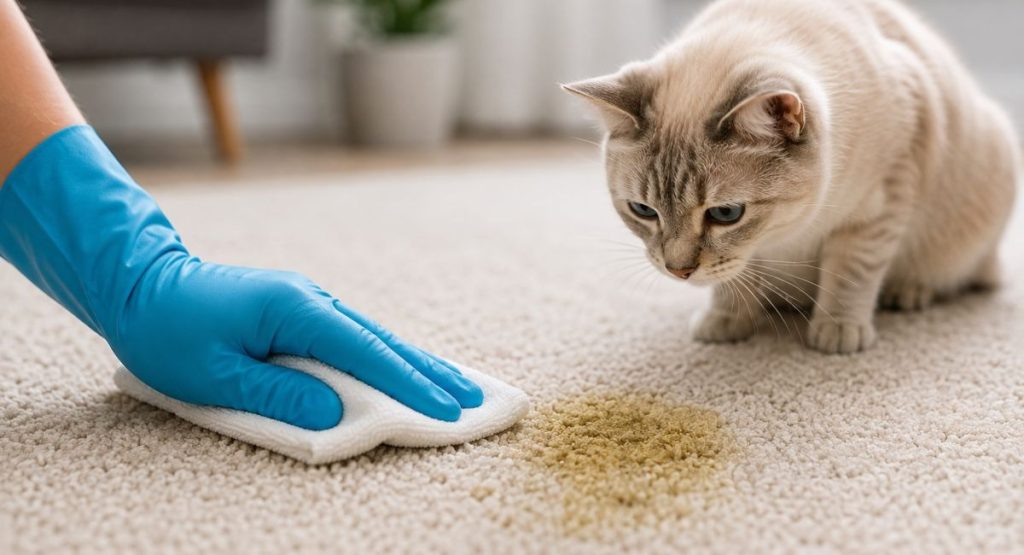
Step 1: Blot Immediately Use clean white paper towels or cloth rags to absorb as much fresh urine as possible. Don’t rub—rubbing pushes the liquid deeper into the fiber and padding. Press down with weight (like a heavy book or flat object) to pull up moisture.
If the spot is wet enough, use a wet/dry vacuum to extract the liquid before it soaks through to the padding.
Step 2: Apply Enzymatic Cleaner Enzymatic cleaners are specifically designed to break down uric acid and urea. Apply the cleaner according to product instructions—usually this means spraying a generous amount on the affected area and allowing it to sit for the recommended time (typically 10 minutes to a few hours).
Recommended products:
- Nature’s Miracle Urine Destroyer Plus for Cats
- Rocco & Roxie Professional Strength Stain & Odor Eliminator
- Urine Away Stain and Odor Eliminator
Step 3: Blot Again After the recommended sitting time, blot the area thoroughly with clean towels to remove the enzymatic cleaner. Extract as much moisture as possible—wet carpet can develop mold and mildew if not dried quickly.
Step 4: Dry Completely Use fans, open windows, or a dehumidifier to dry the area as quickly as possible. Incomplete drying can trap moisture and bacteria in the padding, which continues to produce odor.
For Dried or Set-In Cat Urine Stains
If the stain has been sitting for hours, days, or longer, fresh treatment is more complex:
Step 1: Identify the Full Extent A black light (UV flashlight) reveals dried cat urine that’s invisible to the naked eye. Use this to map out all affected areas—the spot is always larger than you think.
Step 2: Use an Enzymatic Cleaner with Extended Dwell Time Dried urine requires the enzyme cleaner to sit longer to penetrate and break down crystallized deposits. Allow 2-4 hours or even overnight, depending on the product. Keep the area damp under plastic sheeting to prevent the cleaner from drying out.
Step 3: Flush the Carpet After the enzymatic cleaner has sat, rinse the area thoroughly with clean water. A wet/dry vacuum is ideal for this step. You want to remove all cleaner residue and loosened urine components.
Step 4: Remove Moisture Extract all remaining moisture with a wet vacuum, then use towels and weighted objects to pull out remaining water. Leave fans running for 24-48 hours to ensure complete dryness.
Enzymatic Cleaners vs. Other Methods
Enzymatic Cleaners (Most Effective)
- Break down uric acid crystals at the molecular level
- Neutralize odors rather than masking them
- Prevent cats from re-marking the same spot
- Cost: $15-40 per bottle
Vinegar and Baking Soda (Limited Effectiveness)
- Vinegar’s acidity neutralizes some ammonia but doesn’t dissolve uric acid crystals
- Baking soda absorbs some odor but doesn’t remove the underlying stain
- Better for fresh, light accidents than set-in stains
- Often used in combination for mild cases
Hydrogen Peroxide (Risky)
- Can bleach carpet fibers, causing permanent discoloration
- More effective on organic matter but less effective specifically on uric acid
- Must be diluted and tested on hidden areas first
Odor Masking Products (Avoid)
- Air fresheners and scented products mask smell temporarily but don’t solve the problem
- Cats can still smell the pheromone markers underneath
- Can actually encourage re-marking
Ammonia-Based Cleaners (Never Use)
- Ammonia smells similar to cat urine and can actually encourage re-marking
- Mask the underlying problem rather than solving it
Professional Cat Urine Carpet Cleaning
For stubborn or extensive cat urine damage, professional cleaning is the only truly effective solution. Here’s why:
Professional-Grade Equipment
Professional carpet cleaners use equipment far more powerful than rental machines or consumer products:
- Extraction equipment that pulls contaminated moisture deep from the padding and subfloor
- Thermal water system that heats water for better enzyme activation
- Moisture meters to verify complete dryness and ensure padding won’t trap residual moisture
Moisture Control
Incomplete drying is a major reason DIY treatments fail. Moisture trapped in padding continues to produce odor as bacteria break down urine components. Professional equipment can extract water down to the subfloor level, preventing bacterial growth.
Custom Treatment Plans
Each urine situation is different. A professional assessment uses:
- Black light inspection to identify all contaminated areas
- Moisture probes to determine how deep the penetration extends
- Specialized techniques chosen based on carpet type (wool, synthetic, etc.)
When Professional Cleaning Is Necessary
- Multiple incidents in the same area
- Urine that’s penetrated through padding to the subfloor
- Wool or specialty carpet (which requires different cleaning than standard synthetic)
- Persistent odor that DIY methods haven’t resolved
- Extensive contamination that requires multiple treatment sessions
Professional cat urine cleaning costs $300-800+ depending on the affected area and severity, but it’s significantly cheaper than carpet replacement.
Preventing Cat Urine Accidents: What Owners Should Know
The best cat urine solution is preventing accidents in the first place.
Why Cats Urinate Outside the Litter Box
- Medical issues — urinary tract infections (UTIs) are the most common cause; see a vet immediately
- Stress or anxiety — changes in the home, new pets, or loud noises trigger marking
- Litter box problems — dirty box, wrong location, or insufficient number of boxes (rule: one box per cat plus one extra)
- Territorial marking — male cats and spayed/neutered cats still mark territory, especially in multi-cat homes
Prevention Strategies
- Ensure litter boxes are clean and scooped daily
- Provide multiple litter boxes in different locations
- Use enzymatic cleaner immediately on any accident to prevent re-marking
- Address medical issues through veterinary care
- Use calming supplements or Feliway diffusers to reduce stress-related marking
- Provide adequate resources so cats don’t compete for territory
Once a cat has marked a spot, it will continue returning unless you completely eliminate the smell—including the invisible uric acid crystals.
When to Replace Carpet vs. Professional Cleaning
Not every cat urine situation requires carpet replacement. Here’s how to decide:
Professional Cleaning Is Appropriate When:
- The accident is isolated to one or two small areas
- The urine hasn’t penetrated all the way through to the subfloor
- You catch the accident within 24-48 hours
- The carpet fiber is still in good condition overall
- The padding shows no visible damage or mold
Carpet Replacement Is Necessary When:
- Multiple areas of the home have chronic cat urine contamination
- The odor returns after professional cleaning (indicates subfloor contamination)
- The padding is visibly stained, moldy, or deteriorated
- The subfloor shows water damage or staining
- The carpet is older and already worn
If urine has reached the subfloor, cleaning alone won’t solve the problem. The subfloor will continue producing odor, and the moisture damage will encourage mold growth. In these cases, carpet replacement (including padding and subfloor treatment) is the only permanent solution.
FAQs
Q1: Can you completely remove cat urine smell from carpet?
Yes, if you act quickly and use the right methods. Fresh accidents can be completely eliminated with enzymatic cleaners within hours. For older stains, professional cleaning can remove most or all of the odor, but if urine has reached the subfloor, complete removal may require carpet replacement. The key is using enzymatic cleaners—vinegar and baking soda alone won’t dissolve uric acid crystals.
Q2: Why does the cat urine smell come back after cleaning?
The smell returns when uric acid crystals remain in the carpet fiber or padding, or when contamination has reached the subfloor. Cats can smell these crystals (even if humans can’t), which triggers re-marking. This is why enzymatic cleaners are essential—they actually dissolve the crystals rather than just covering up the smell. If odor returns after enzyme treatment, the contamination has likely reached deeper layers that require professional extraction.
Q3: How long does it take enzymatic cleaner to work on cat urine?
Most enzymatic cleaners require 10 minutes to several hours of dwell time. Older, dried stains need longer—often 4-8 hours or overnight. The enzyme needs time to penetrate the fiber and break down uric acid crystals. Rushing this step reduces effectiveness. Always follow the product instructions for the specific cleaner you’re using.
Q4: Is cat urine dangerous to breathe in?
Cat urine contains ammonia and bacteria that can be irritating to breathe, especially in high concentrations or for people with respiratory sensitivities. The ammonia odor you smell is a sign that bacterial breakdown is occurring. This is why ventilation is important during cleaning. For safety, wear gloves when handling urine and ensure good airflow in the affected area.
Final Thoughts
Cat urine carpet cleaning is genuinely harder than dog urine cleanup, and understanding why makes a real difference in solving the problem. The concentrated nature of cat urine, the formation of insoluble uric acid crystals, and cats’ instinct to repeatedly mark the same spot all combine to create a challenge that requires specific treatment strategies.
The most important thing you can do is act fast. A fresh cat urine accident can be completely eliminated with the right enzymatic cleaner in a matter of hours. But if you wait days or weeks, the uric acid crystallizes, sinks deeper into the padding, and becomes exponentially harder to remove. At that point, professional cleaning isn’t optional—it’s the only effective solution.
hi, good
That was amazing
thank