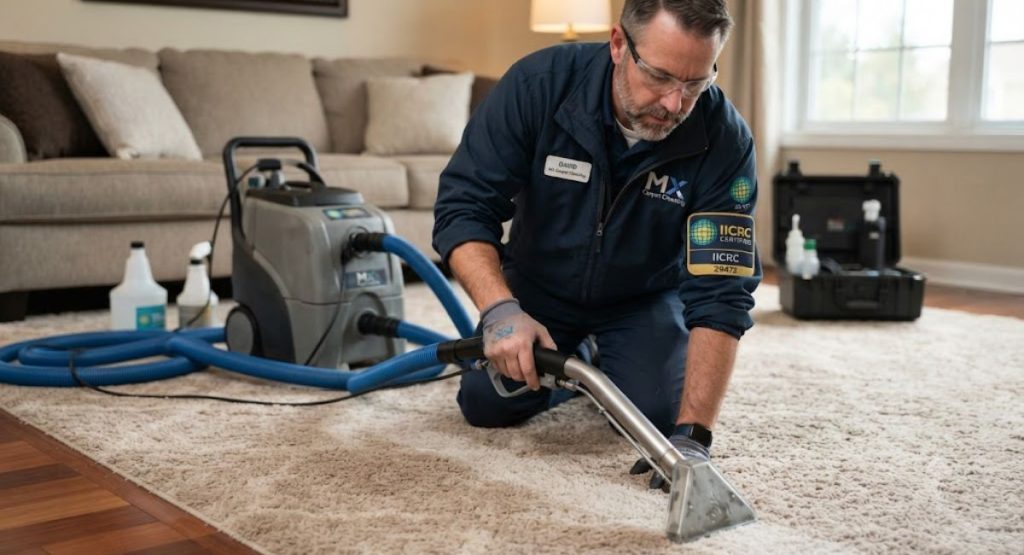
A carpet cleaner becomes IICRC certified by completing an IICRC-approved training course, passing a written exam covering fiber types, cleaning chemistry, and equipment, and agreeing to follow the IICRC’s Code of Ethics. That’s the short answer. The certification itself comes from the Institute of Inspection, Cleaning and Restoration Certification (IICRC) the independent standards body most of the professional cleaning and restoration industry trains against.
Below is the longer version: what the training actually covers, the difference between a Certified Technician and a Certified Firm, how to verify a company’s certification before you hire them, and what certification does and doesn’t guarantee.
What Is IICRC Certification, Exactly?
The IICRC is a non-profit, independent standards-setting body for the cleaning, inspection, and restoration industry. It was founded in 1972 and develops the technical standards professional carpet cleaners are trained against, including S100, the reference standard for carpet cleaning.
IICRC certification isn’t a business license. A license just means a company paid a registration fee to legally operate, it says nothing about how well the work actually gets done. IICRC certification means a technician sat through a course, passed a written exam, and demonstrated they understand fiber identification, cleaning chemistry, equipment operation, and technique well enough to pass a test on it.
What Makes a Carpet Cleaner IICRC Certified? (The 4 Steps)
Becoming an IICRC Certified Technician takes four steps:
- Enroll in an IICRC-approved course. Carpet Cleaning Technician (CCT) is the standard entry-level certification and the one most working carpet cleaners hold. There are no prerequisites — anyone can enroll, which is part of why certification, not just years of “experience,” is the more reliable thing to check for.
- Complete the coursework. CCT training covers fiber and carpet construction, soiling conditions, cleaning chemistry, equipment selection, and pre-inspection procedures — the stuff that determines whether a cleaner treats a Berber the same way they’d treat a wool area rug.
- Pass a written exam. The exam tests whether the material actually stuck, not just attendance.
- Agree to the Code of Ethics and keep the certification current. Certifications require periodic renewal and continuing education, since cleaning chemistry, equipment, and standards keep evolving.
IICRC Certified Technician vs. IICRC Certified Firm
There’s a real distinction here that homeowners often miss.
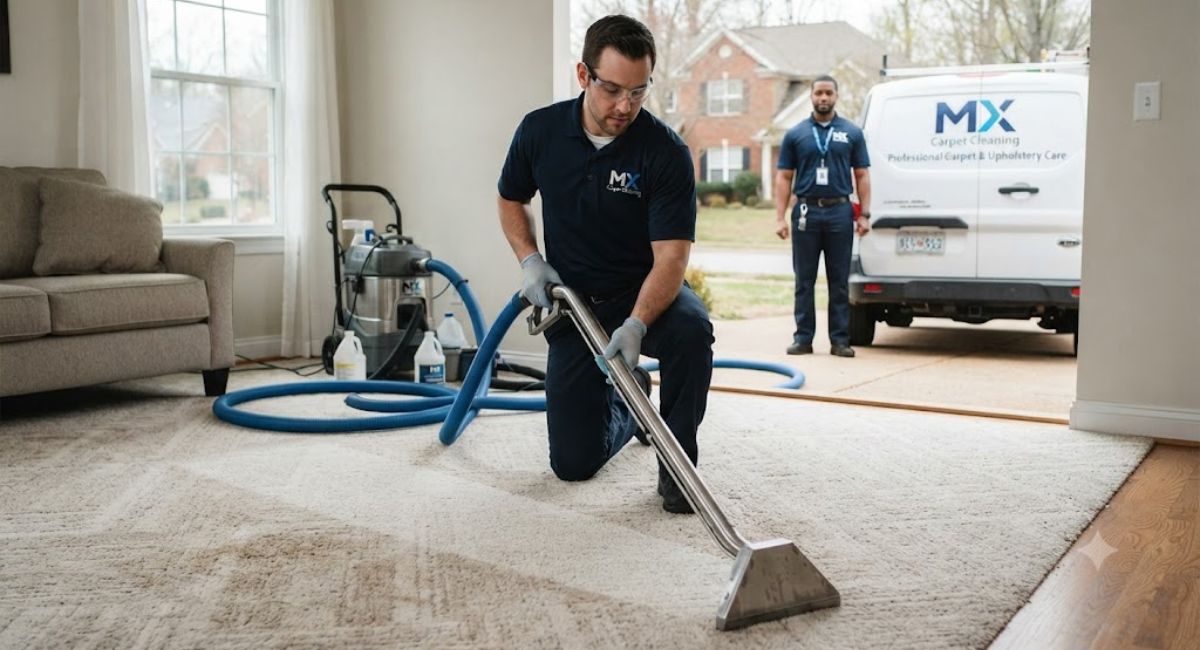
An IICRC Certified Technician is an individual who completed training and passed the exam for a specific specialty — carpet cleaning, upholstery, water damage, and so on. A company can employ certified technicians without the company itself holding any status.
An IICRC Certified Firm is a higher bar for the business as a whole. To hold Firm status, a company has to:
- Keep at least one IICRC-certified technician on staff
- Carry liability insurance
- Maintain a written customer complaint policy
- Follow the IICRC Code of Ethics
- Meet continuing education requirements
MX Carpet Cleaning’s technicians hold IICRC Carpet Cleaning Technician (CCT) certification, the credential that governs how the actual cleaning gets done on every job, from fiber handling to chemistry to drying time.
What IICRC Certification Actually Means for Your Carpet
Here’s what the training translates to when a technician shows up at your door:
- The right method for the fiber. Wool, nylon, olefin, and polyester all react differently to heat, chemistry, and agitation. A high-pH alkaline solution that’s fine on nylon can permanently shrink or discolor wool.
- Correct chemistry. Trained technicians understand pH balance and rinse requirements instead of guessing at dilution ratios.
- The right equipment for the job. Truck-mounted hot water extraction and portable units aren’t interchangeable — used incorrectly, a portable unit can leave carpet damp for 18+ hours, which is more than enough time for mold to start growing.
- Moisture control. Knowing how much water to apply and how much to extract is what keeps carpet drying in hours instead of days.
- Wicking prevention. A stain that seems gone right after cleaning can “wick” back up through the backing days later if the padding underneath wasn’t dried properly. Trained technicians know to watch for this and treat it before it happens, not after.
Common IICRC Certifications to Know
| Certification | What It Covers | Who Needs It |
| CCT — Carpet Cleaning Technician | Fiber ID, cleaning chemistry, equipment, technique | Baseline certification for professional carpet cleaning |
| RRT — Rug Cleaning Technician | Area rugs, including natural-fiber and antique rugs | Specialty rug cleaners |
| UFT — Upholstery and Fabric Cleaning Technician | Fabric identification, upholstery-specific technique | Furniture and upholstery cleaning |
| WRT — Water Damage Restoration Technician | Water categories, structural drying basics | Flood and water damage work |
| AMRT — Applied Microbial Remediation Technician | Mold and microbial contamination | Mold remediation |
| ASD — Applied Structural Drying | Advanced moisture measurement, controlled drying | Large-scale water damage restoration |
How to Verify a Carpet Cleaner’s IICRC Certification
Don’t just take a company’s word for it — verification takes about two minutes.
- Ask for their certification number. A legitimately certified technician or firm will hand it over without hesitation.
- Look it up yourself. IICRC maintains a public directory at iicrc.org where you can search by technician name, company name, or certification number.
- Treat a mismatch as a red flag. If a company advertises “IICRC Certified” but doesn’t show up in the directory, or hedges when you ask for a certification number, ask more questions before booking.
What IICRC Certification Does Not Guarantee
Certification confirms technical knowledge — it doesn’t confirm pricing transparency, punctuality, or customer service. A certified technician can still quote low and upsell on-site, or run late without calling. Certification is a necessary check, not the only one worth doing. Pair it with real reviews, a clear written quote before the job starts, and a willingness to explain the process.
Why This Matters for Guelph Homes
Guelph’s climate makes moisture control and correct chemistry especially relevant. A humid summer stretch can turn an over-wet basement carpet into a mold problem within 24 to 48 hours. Salt and de-icer tracked in over an Ontario winter leaves residue that, if it’s not rinsed with the right solution, can dull or damage fibers over time. That’s exactly the kind of judgment IICRC training is built around.
MX Carpet Cleaning’s technicians are IICRC Carpet Cleaning Technician (CCT) certified, which is why every job follows that standard for fiber handling, chemistry, and drying time — not guesswork based on how a carpet “usually” reacts.
FAQs
Is IICRC certification legally required to clean carpets in Ontario?
No. Carpet cleaning isn’t a licensed trade in Ontario, so technically anyone can start a business without certification. IICRC certification is a voluntary, industry-recognized standard which is exactly why it’s worth checking for before you hire.
How much does it cost to become IICRC certified?
Course and exam fees for a single certification like CCT typically run a few hundred dollars, plus the technician’s time in training. Costs vary by provider and whether the course is in-person or live-stream.
What’s the difference between an IICRC Certified Technician and an IICRC Certified Firm?
A Certified Technician is an individual who passed the training and exam. A Certified Firm is a company that meets a higher bar overall — at least one certified technician on staff, liability insurance, a written complaint policy, and adherence to the Code of Ethics.
Does hiring an IICRC certified cleaner guarantee good results?
Certification confirms the technician was trained and tested on proper technique — it doesn’t guarantee pricing, punctuality, or customer service on its own. Combine it with real reviews and a written quote before booking.
Final Thoughts
IICRC certification isn’t a marketing sticker,it’s a real credential that means a technician sat through training, passed an exam, and agreed to a code of ethics before ever touching your carpet. It’s not a substitute for common sense, though: still ask for a certification number, check the directory yourself, and get a written quote before anyone starts work. MX Carpet Cleaning’s technicians hold IICRC Carpet Cleaning Technician (CCT) certification, which is why we’d rather Guelph homeowners verify it themselves at iicrc.org than just take our word for it.